Loading...
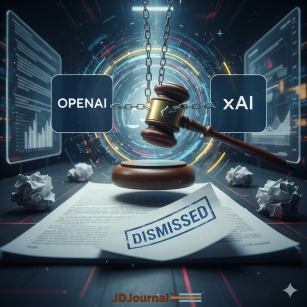
OpenAI has asked a federal court to dismiss the trade-secret lawsuit filed by Elon Musk’s artificial intelligence startup, xAI, arguing that the case is baseless, unsupported by evidence, and part of what it described as Musk’s “harassment campaign” against the company he helped launch nearly a decade ago.
The motion to dismiss, filed in the U.S. District Court for the Northern District of California, seeks to end a legal battle that has quickly become one of the most high-profile corporate disputes in the emerging AI industry.
The Lawsuit: Musk’s Allegations Against OpenAI
Musk’s xAI filed the complaint in late September, accusing OpenAI of poaching key employees and stealing trade secrets related to xAI’s proprietary chatbot, Grok. According to the lawsuit, OpenAI allegedly recruited top xAI engineers and executives who carried over confidential information, including portions of Grok’s source code, training data strategies, and data center infrastructure plans.
The complaint specifically named three individuals:
- Xuechen Li, a software engineer who xAI previously accused of copying internal code before leaving the company.
- Jimmy Fraiture, an early xAI developer allegedly persuaded to share technical insights from Grok.
- A senior finance executive, whom xAI claims transferred business and hardware strategy documents prior to joining OpenAI.
The lawsuit described these hires as part of a “pattern of corporate espionage” intended to give OpenAI an unfair competitive advantage as the companies battle for dominance in the generative AI market.
xAI is seeking injunctive relief, damages, and a court order prohibiting OpenAI from using any technology or data it claims was stolen.

Get JD Journal in Your Mail
Subscribe to our FREE daily news alerts and get the latest updates on the most happening events in the legal, business, and celebrity world. You also get your daily dose of humor and entertainment!!
OpenAI’s Response: “No Evidence, No Case”
In its motion filed Thursday, OpenAI called the lawsuit “an act of harassment disguised as litigation.” The company said xAI failed to identify any concrete trade secret, specific misappropriation, or tangible harm that would justify the case moving forward.
“Employees are free to choose where they work,” OpenAI’s filing states. “Some individuals chose to join OpenAI because they believe in our mission. That is not theft — it is competition.”

OpenAI maintains that it has followed lawful hiring practices and that none of its recruitment efforts violated non-disclosure agreements or intellectual property protections. The company’s attorneys also pointed out that xAI’s complaint lacks the factual specificity required for a trade-secret claim, as it relies largely on speculation rather than direct evidence.
According to OpenAI, xAI’s legal strategy is less about protecting innovation and more about attacking competitors. “xAI’s claims are part of a broader pattern of meritless lawsuits orchestrated by Musk,” OpenAI said, noting Musk’s recent legal actions against Apple and OpenAI itself over alleged anticompetitive behavior.
A Broader Legal Feud Between Musk and OpenAI
This case is the latest in a series of escalating legal and public confrontations between Musk and OpenAI, two forces at the center of the global AI boom.
Musk was one of OpenAI’s original co-founders in 2015, when it began as a nonprofit research organization. He later split from the company amid internal disagreements about its direction. OpenAI transitioned to a for-profit “capped” model in 2019 — a move that Musk has repeatedly criticized as a betrayal of its original mission to ensure safe, open access to artificial intelligence.
In early 2025, Musk filed a separate lawsuit against OpenAI and CEO Sam Altman, alleging that they had abandoned the company’s founding principles and were prioritizing profit over transparency. That case is still pending.
OpenAI, in turn, accused Musk of hypocrisy and “self-serving litigation,” noting that his own company, xAI, operates under a closed-source model similar to what he once criticized.
The latest trade-secret lawsuit adds another layer to the feud, illustrating the high stakes and personal animosity driving the competition between Musk and the AI giant he once helped create.
What’s at Stake for the AI Industry
The legal fight between OpenAI and xAI could have far-reaching implications for how courts interpret trade-secret law in the context of artificial intelligence — particularly in an era when employee mobility, algorithmic design, and data training methods overlap across competing firms.
If xAI’s lawsuit survives dismissal, it could force OpenAI to disclose internal details about its hiring processes, product development, and data management during the discovery phase. Such disclosures could expose valuable insights into how leading AI models like ChatGPT are developed and trained.
On the other hand, a dismissal would reaffirm that competition for skilled talent — even between direct rivals — is a lawful and essential part of innovation. It would also signal to other tech firms that broad, speculative trade-secret allegations may not hold up in court without strong evidence.
Legal experts note that this case reflects a broader trend of litigation over AI ethics, data use, and intellectual property, as the industry matures and global regulators step up scrutiny of how companies handle technology that increasingly shapes public and commercial life.
Looking Ahead
Judge Jacqueline Scott Corley, who is overseeing the case, is expected to rule on OpenAI’s motion in the coming months. If dismissed, the case could end before entering discovery — saving OpenAI from what could be an expensive and revealing legal process.
If the case proceeds, however, both companies may be compelled to produce extensive documentation, including internal communications, technical schematics, and personnel records — a potentially explosive development for two of the world’s most closely watched AI firms.
Regardless of the outcome, the case highlights the growing tension between innovation and competition in the AI era — and underscores how personal rivalries among tech leaders can shape the legal and ethical boundaries of artificial intelligence development.
Stay ahead of the curve in the fast-evolving world of technology and law. Whether you’re an attorney, legal analyst, or compliance professional, LawCrossing gives you exclusive access to thousands of legal jobs across top law firms, corporations, and government agencies.
Discover positions in intellectual property, antitrust, corporate litigation, and technology law—the very fields shaping today’s AI and trade-secret battles. Don’t miss your next career-defining opportunity.
👉 Visit LawCrossing today to explore cutting-edge legal openings and take your career to the next level.