Loading...
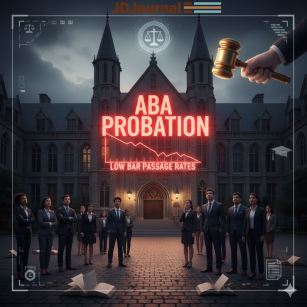
In a significant move that could impact hundreds of current and prospective law students, the American Bar Association (ABA) has placed Cooley Law School on probation, citing its failure to meet required bar exam passage benchmarks. This decision raises urgent questions about admissions practices, educational outcomes, and the future accreditation status of one of the country’s most widely known law schools.
The Core Issue: Standard 316 Compliance
At the heart of the ABA’s decision is Standard 316, which requires that at least 75% of a law school’s graduates who sit for the bar must pass within two years of graduation. This benchmark is one of the most critical accreditation standards, designed to ensure that students are receiving a legal education that adequately prepares them to enter the profession.
For years, Cooley has struggled to meet this standard. While national bar passage rates have been trending upward—nearing 83% for first-time takers in 2024—Cooley’s “ultimate bar passage” rate has consistently fallen below the required threshold. Reports show some graduating classes achieving rates closer to 50–60%, which raised serious red flags for regulators.
Cooley’s History of Scrutiny
This is not Cooley’s first encounter with the ABA over its compliance record. The school has previously been sanctioned for admissions policies that the ABA found allowed too many students unlikely to succeed academically or professionally. Critics have long argued that Cooley’s relatively open admissions policies, while expanding access to legal education, also contribute to higher student debt and lower post-graduation outcomes.
The probation status represents an escalation in oversight. Under ABA rules, probation signals that a school is substantially out of compliance and must take immediate steps to correct deficiencies or risk losing accreditation entirely.
What Probation Means for Students
Probation does not immediately strip a school of its accreditation. Students currently enrolled can still graduate with an ABA-accredited degree, and graduates remain eligible to sit for the bar in most states. However, probation can carry reputational consequences and may influence prospective students’ decisions to apply or matriculate.

Get JD Journal in Your Mail
Subscribe to our FREE daily news alerts and get the latest updates on the most happening events in the legal, business, and celebrity world. You also get your daily dose of humor and entertainment!!
If Cooley fails to improve its bar passage outcomes and demonstrate compliance, the ABA has the authority to remove its accreditation, a move that would severely limit graduates’ ability to practice law in many jurisdictions.
Steps Cooley Will Be Required to Take
To exit probation, Cooley must present the ABA with a detailed remediation plan and show measurable improvement. This typically includes:

- Revising admissions criteria to ensure incoming students have a realistic likelihood of completing their J.D. and passing the bar.
- Expanding academic support programs, such as bar prep courses, tutoring, and early intervention systems for at-risk students.
- Adjusting curriculum to align more closely with bar-tested subjects.
- Tracking and reporting outcomes with greater transparency so the ABA can monitor progress.
Cooley will remain under close observation and must file regular reports demonstrating that its reforms are effective.
Broader Implications for Legal Education
The ABA’s action highlights an ongoing tension in legal education: balancing access with quality control. Cooley has historically been one of the largest law schools in the U.S. by enrollment, emphasizing access and opportunity for nontraditional students. Its critics argue that this approach comes at the cost of student success metrics, leaving too many graduates burdened with debt and unable to practice.
This case also reflects a broader national conversation. Several other law schools have come under review for bar passage rates that failed to meet the ABA’s threshold. Since Standard 316 was tightened in 2019, schools have had less room to argue that poor results were caused by temporary fluctuations or external factors.
What Prospective Students Should Consider
For prospective law students, this decision underscores the importance of researching a school’s bar passage statistics before enrolling. The ABA now requires accredited law schools to publish detailed data on bar passage, employment outcomes, and cost of attendance—information that should factor heavily into decision-making.
Students considering Cooley should be aware of both the risks and the school’s plans to improve. While probation is a serious status, some schools have successfully rebounded, improved outcomes, and returned to good standing. Others, however, have ultimately lost accreditation.
Looking Ahead
Cooley now faces a critical period where it must demonstrate its ability to meet the ABA’s high standards and protect its accreditation status. The coming months will reveal whether the school can make the systemic changes needed to support student success and restore confidence in its J.D. program.
The ABA’s action serves as a reminder that accreditation is not permanent and that regulatory bodies are increasingly willing to hold law schools accountable for outcomes that directly affect students’ ability to join the profession.
Thinking About Law School or a Legal Career?
If Cooley’s probation status has you rethinking your options, now is the time to explore schools and career paths that set you up for success. Visit LawCrossing to research top law schools, bar passage statistics, and legal job opportunities that align with your goals. Don’t leave your future to chance—plan your path to a thriving legal career today!
See Related Articles:
•15 Top Law Schools: Best Program for Aspiring Lawyers
•Decode Law Schools Ranking
•Law School Profile